In this article
- The fair ends. The evaluation does not
- A sales investment that needs digital continuity
- Buyers reach sales with much of the decision already made
- Results in figures
- One in five companies published different official values
- Two real errors found in the sample
- When the brand is not in the question
- Other friction points: languages, tables and links
- Why data quality matters for AI too
- From technical finding to commercial impact
- Nine practical measures, in three priorities
- Conclusion: what it means for manufacturers
- How the study was carried out
- Sources
The fair ends. The evaluation does not
The stand comes down, the sales teams fly home and the decisive phase begins: following up on contacts, clarifying technical requirements, sending datasheets and turning conversations in the hall into real opportunities. For the industrial buyer, research continues for weeks at their desk: they review the manufacturer's website, download catalogues, compare alternatives and ask AI assistants.
Along the way, a seemingly minor inconsistency can stall the deal. If the same component appears with different dimensions on the website and in an official PDF, the engineer or buyer has to work out which value is valid. If a technical table labels its columns only with icons, an automated system may attach a value to the wrong attribute. And if the brand does not come up when someone searches for a technical solution without naming suppliers, it is left out of the first comparison.
A sales investment that needs digital continuity
In its Aussteller-Ausblick 2026/2027 report, AUMA, the Association of the German Trade Fair Industry, notes that around 49% of the 404 exhibiting companies surveyed judge the success of their participation by contacts, opportunities and new customers, while roughly one in ten barely measures results at all.
In Spain, the Spanish Trade Fair Association (AFE) counted 472 trade fairs and business events among its members in 2025, with 64,236 exhibitors and 6.8 million visitors. These are activity figures, not measures of return per stand, but they show why it matters to protect the continuity between the face-to-face conversation and the technical data the buyer looks up afterwards.
Buyers reach sales with much of the decision already made
According to McKinsey's Global B2B Pulse 2026, a survey of around 4,000 decision-makers in 13 countries, buyers use an average of ten channels along their journey, and inconsistent information is among the direct reasons for switching suppliers. Generative AI is already one of the top five channels for discovering and evaluating suppliers.
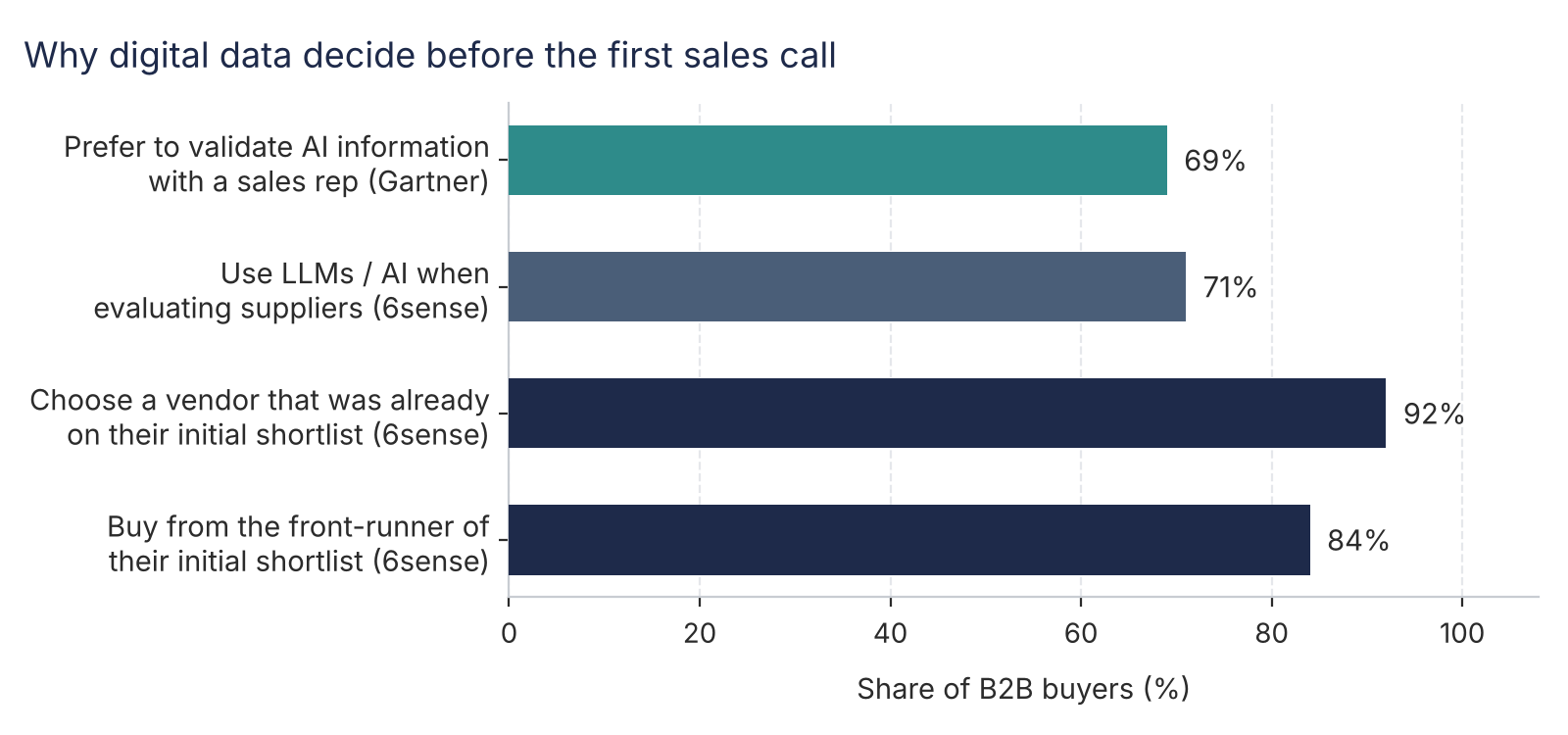
6sense's European research adds that in 92% of the B2B purchases studied, the chosen vendor was already on the initial shortlist, and that 84% ended up buying from the vendor they favoured before speaking to a salesperson. 71% of buyers used large language models during their evaluation. And according to Gartner (May 2026, n=645), 69% prefer to check AI-generated information with a sales rep. These are cross-industry B2B samples, not specific to industrial components, but the message is clear: the information available before the sales call shapes preferences.
Results in figures
| Indicator | Result |
|---|---|
| Manufacturers with contradictory official sources | 10 of 50 (20%) |
| Wrong AI answers due to problems with the structure or availability of information | 3 of 50 (6%) |
| Critical documentation friction (sum of the two rows above) | 13 of 50 (26%) |
| Unprompted AI warnings about contradictory sources | 0 of 10 (0%) |
| Correct reference in branded queries | 47 of 50 (94%) |
| Manufacturers missing from unbranded queries | 25 of 50 (50%) |
| Correct and stable technical value when documentation was consistent (assessable companies) | 33 of 40 (82.5%) |
| No German web version for the product ranges analysed | 9 of 50 (18%) |
| Poor machine translation or mixed languages | 7 of 50 (14%) |
Exploratory results from a sample of 50 manufacturers: they describe the sample, not the industry as a whole.
One in five companies published different official values
The first phase of the study examined public information from manufacturers whose products can be identified by a technical part number. Web pages in different languages were compared with official PDF documentation, and we observed how ChatGPT answered questions phrased the way a technical buyer would ask them.
For 10 of the 50 manufacturers, at least two official sources gave different values for the same parameter: a dimension, a rating, a piece count or another technical attribute. The discrepancies appeared between the website and a downloadable datasheet, between documents from different years, or even within the same page.
When ChatGPT was asked about the attribute in question in those ten cases, it never warned on its own initiative that conflicting versions existed:
- In five cases it matched the value on the website.
- In three, the value in a PDF or catalogue.
- In one, the title or metadata.
- In one, the best-supported value among the available sources.
The test asked for a specific specification, not a documentation audit. That is exactly why it illustrates the risk a buyer faces when asking a direct technical question. It is therefore worth verifying AI recommendations against the official documentation, part number by part number, instead of taking the first answer at face value.
Two real errors found in the sample
The scale error ("1 mm" instead of "1 m"). A datasheet showed "1 mm" for a length that other official documentation from the same manufacturer put at over one metre. A discrepancy of that size can lead to a misleading comparison and forces the buyer to ask for confirmation.
"Zombie" catalogues. Among the indexed sources were catalogues from 2007, 2017, 2018 or 2022, accessible alongside recent documentation. An old date does not invalidate a document, but nor does it show whether it is still valid, or which version should prevail when the values differ.
When the brand is not in the question
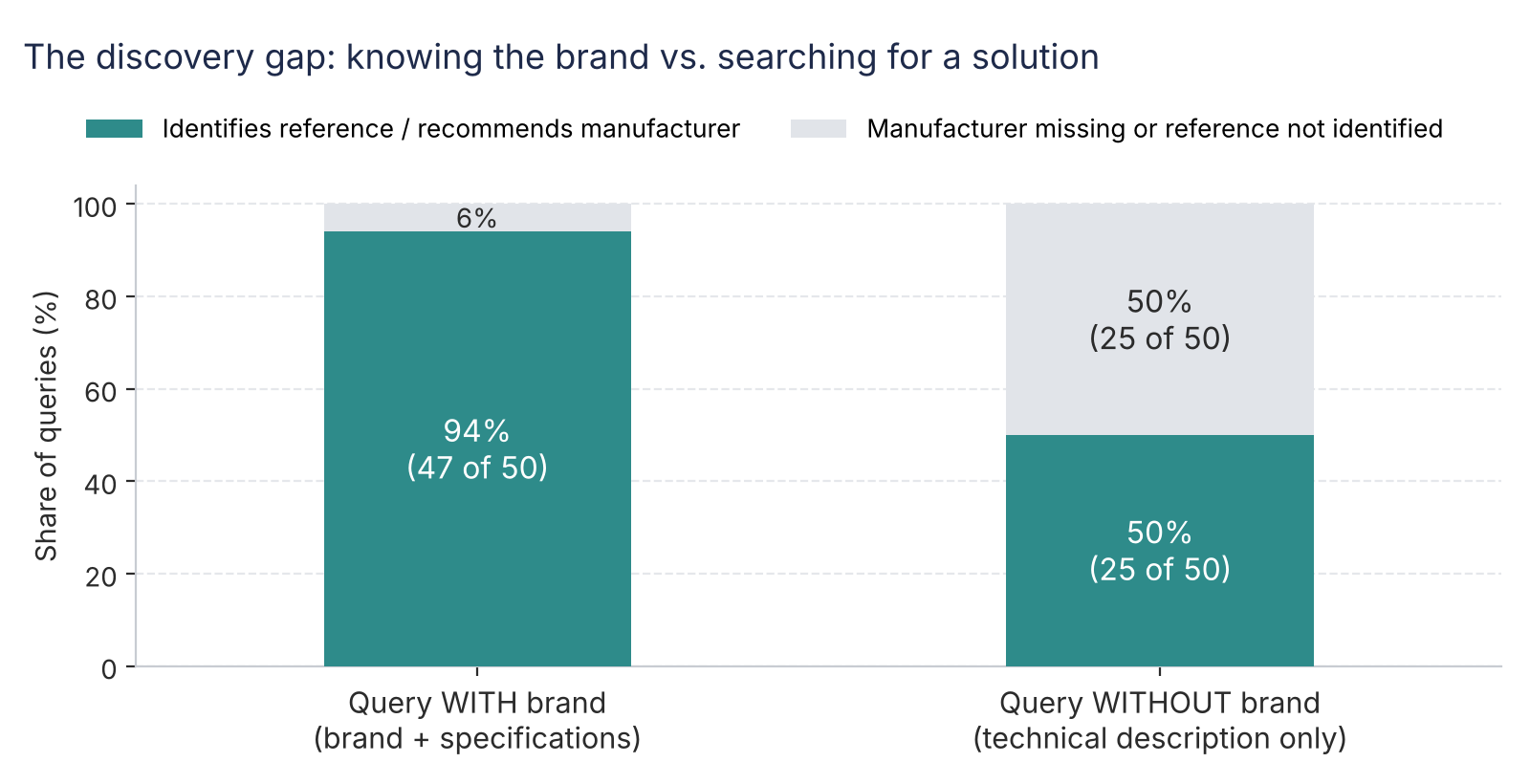
When the query named the manufacturer and included specifications, ChatGPT identified the correct reference in 47 of 50 cases. With a descriptive, unbranded question, 25 manufacturers did not appear among the suggested options.
Since this was a single query per manufacturer, that 50% is not an overall visibility share, nor does it mean those companies are "invisible" to AI. It does point to a commercial gap: being recognisable when the buyer already knows the brand does not guarantee being among the options while they are still looking for a technical solution.
Other friction points: languages, tables and links
Beyond the main attributes, the analysis recorded other obstacles: 9 manufacturers had no German web version for the ranges analysed, and 7 showed poor machine translation or a mix of languages. We also found hard-to-read tables, broken links and language switchers that led to a different product. These observations were not added to the 26% of main findings.
The study reviewed Spanish, German and English versions, but the lesson applies to any export language and market, whether Germany, France, Italy, Poland or the United States: a part number must keep its identity, attributes and units intact when it changes language. Machine translation without technical review does not guarantee that. Multilingual product information has to be managed like any other technical data, with approved terminology and the same source for every language.
Why data quality matters for AI too
AI assistants combine learned knowledge with information retrieved from web pages and indexed documents. In industrial settings, accuracy requires unambiguous answers to four questions: the exact part number, the attribute each value belongs to, its unit and the current version of the datasheet.
A 2025 study by the Laboratory for Machine Tools and Production Engineering (WZL) at RWTH Aachen University and Fraunhofer IPT, published in wt Werkstattstechnik online, analysed textual data quality problems in industrial systems based on language models, using documentation from an automotive supplier. It addresses a different application, but its conclusions match: automated systems need structured, unambiguous and verifiable technical information.
Multilingualism adds another layer. Research presented at ACL 2026 on multilingual retrieval-augmented generation found biases in source selection that favour English and the language of the query. It does not prove that ChatGPT always follows this pattern, but it is a good reason to check separately what AI answers in each market language.
Industry standards exist to structure this information, such as ETIM, which defines classes, features, values and units for technical products, and ECLASS, a master data model that can be exchanged across systems, industries and languages. They help consistency, although the accuracy of AI recommendations still needs regular checks.
Much of the market approaches these issues as GEO (Generative Engine Optimization): getting ChatGPT, Gemini or Perplexity to mention and cite a brand. The study points to a prior question. An AI that names the manufacturer is of little use if the technical value it passes on is wrong. So besides visibility in search engines and AI, it pays to check how accurately AI describes each part number.
From technical finding to commercial impact
A contradictory specification can trigger a clarification request, delay a quote or complicate the comparison with a competitor. These are plausible friction mechanisms: the study did not measure lost sales, returns or trade fair ROI, nor does it allow a specific commercial loss to be attributed to ChatGPT.
To quantify the impact in a given company, the next step is to cross-check such audits with internal indicators: pre-sales questions about part numbers, engineering hours spent on clarifications, time from enquiry to quote, reasons for lost deals and documentation issues in after-sales.
Nine practical measures, in three priorities
1. One reliable version of every value
- Centralise product master attributes and assign a technical approver for every change.
- Withdraw superseded catalogues or clearly mark them as obsolete, keeping version and date.
- Communicate technical updates to distributors, industry portals and sales teams.
2. Information that people and machines can read
- Publish critical specifications in clean HTML as well, not only in PDF.
- Use text table headers, explicit units and stable part identifiers.
- Automate pre-publication checks for extreme values (such as a jump from millimetres to metres), empty fields and broken links.
3. International consistency and AI verification
- Check every part number in every language you sell in: units, approved technical terminology and the hreflang tags that tell search engines which page belongs to which language.
- Adopt ETIM or ECLASS where they make the catalogue more interoperable.
- Regularly simulate real buyer queries, with and without the brand and in each market's language, to see which variants AI suggests and which sources it cites.
Conclusion: what it means for manufacturers
The stand lets you show the product, answer questions face to face and build trust. Once the lights go out in the hall, the website, PDF catalogues, distributor datasheets and AI assistants' answers take over. For a manufacturer with technical catalogues and a presence in several markets, consistency across all these touchpoints is not a marketing detail: it is a condition for selling.
The practical lesson of the study fits into three questions any manufacturer can ask about its key part numbers:
- Do the technical data match on the website, in the PDF datasheets and in every language?
- What does AI answer when a buyer asks about that part number, and which source does the value come from?
- Does the company appear when the buyer describes the technical need without naming brands?
If any answer is "no" or "I don't know", the first step is not a new platform, but a review of what is published, who approves it and which outdated documents are still online. To analyse a full product range, in several languages and against competitors, Verbinex offers the Market Check.
Free quick test: what does AI say about your product?
Tell us one product or product family. We ask ChatGPT three questions the way a technical buyer would, using the information publicly available online, and email you what it answered, which source it used and whether it matches your datasheet. Free and without obligation.
How the study was carried out
Sample. From a directory of 622 exhibitors at Advanced Manufacturing Madrid 2026, we defined a frame of 137 companies with verifiable technical products. From that frame, a random sample of 50 valid manufacturers was drawn; eight records from the initial selection were replaced in draw order because they did not meet the criteria or their website was unreachable.
Fieldwork. Between 1 and 12 November 2026, two part numbers and three technical attributes were reviewed per manufacturer, comparing web pages and official datasheets in different languages. ChatGPT was used without logging in, with three types of query: unbranded discovery, branded identification and a technical attribute check repeated three times. In the ten cases with contradictory sources, accuracy was not scored because there was no single official value; this is why the stable accuracy indicator is calculated on 40 assessable companies.
Limitations. The results are exploratory and describe the sample analysed: they are not extrapolated to the industry as a whole. Only one AI assistant was used, over a specific period, and only two part numbers and three attributes were reviewed per company, so the figures are a minimum. Companies are cited anonymously; the documentation for each case is kept in the Verbinex archive.
Sources
- AUMA. AUMA-Aussteller-Ausblick 2026/2027 (in German). Berlin, 2026.
- Asociación de Ferias Españolas (AFE). El sector ferial español celebra el 11.º Global Exhibitions Day (in Spanish). 2 June 2026.
- McKinsey & Company. The Surprising Economics of B2B Growth. Global B2B Pulse 2026, 28 May 2026.
- Cunningham, K. 2026 B2B Buyer Experience Report, European Edition. 6sense, 2 November 2026.
- Gartner. 69% of B2B Buyers Turn to Sales Reps to Validate AI-Generated Insights. 20 May 2026.
- Wachter, C., et al. Datenqualität bei der Informationsbereitstellung durch LLMs (in German). wt Werkstattstechnik online 115 (2025): 889–896.
- Wang, D., et al. All Languages Matter: Understanding and Mitigating Language Bias in Multilingual RAG. ACL 2026.
- ETIM International. Classification: Model Information. Accessed 15 November 2026.
- ECLASS e.V. Conceptual Data Model. Accessed 15 November 2026.